
CELEBRATING 150 YEARS—Why Sculptures?
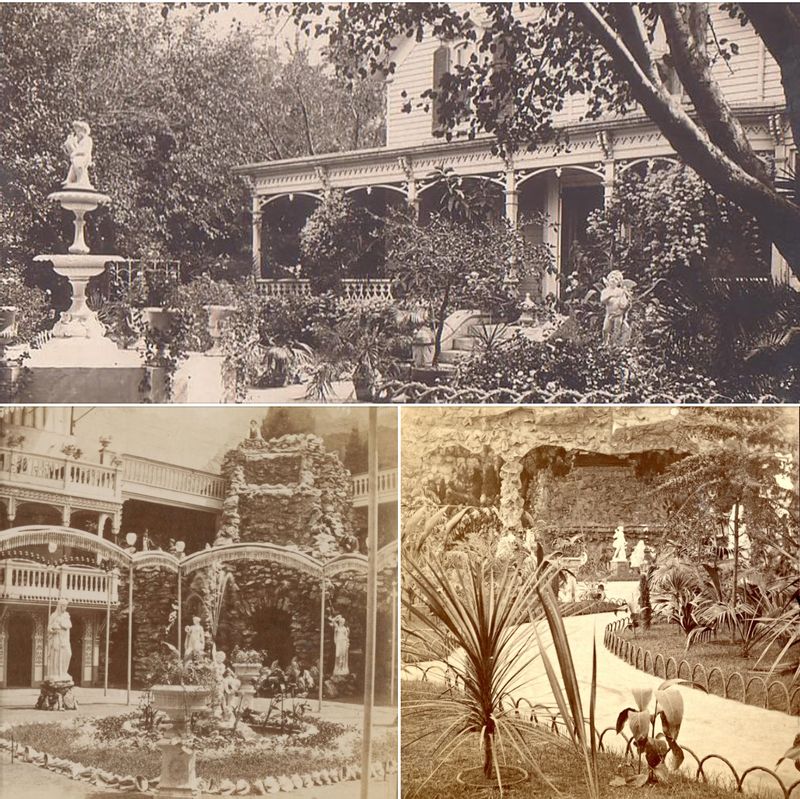
Ever wonder why Charles F. Koester had sculptures in his garden? Credit can be given to his being at the Centennial Exposition in Philadelphia in 1876.
Charles made two trips to the Centennial Exposition in Philadelphia in 1876. His first trip was in May and June. As one of the Centennial Managers for the State of Kansas, he went there to organize and set up the displays at the Kansas and Colorado Building. He returned for a second time in August for 20 days with his new bride, Sylvia Broughten Koester, and his Schmidt nephews and nieces. Charles took time to tend to his responsibilities as a Centennial Manager as well as enjoying the Exposition and the City of Philadelphia with his family.
The vast fairgrounds (285 acres) had five massive exhibition halls showcasing the latest products and innovations in agriculture, industry, and arts from around the world. There was so much to see. Charles was taken with the cataract fountain with its multiple jets, an envelope-making machine that folded flat pieces of paper into bundles of envelopes ready to mail, and a 1,400-horsepower steam engine that supplied power via a pully system to the two main exhibition buildings.
We think that it was here in Philadelphia that Charles was introduced to the statuary and other garden ornamentation that he eventually acquired for his own gardens. It is likely that Charles was paying special attention to garden ornaments and statuary because, according to his account books of Centennial expenses, he purchased a sample book of iron ornaments (company unnamed). Also, two of the companies from which Charles subsequently bought sculptures, urns, chairs, and settees for his gardens, J. L. Mott Iron Works and J. W. Fiske Iron Works, had displays at the Exposition.
What did Charles see while in Philadelphia? Photos from 1876 show sculptures that look like those he acquired for his gardens. For example, Charles, Sylvia, and the children went one evening to Kiralfy’s Alhambra Palace, an entertainment venue that served the crowds of tourists coming to the fair. Among the classical statues at the Alhambra were “Winter” and “Boy with Swan,” both of which are in the Koester garden. The Alhambra’s walkways were lined with conch shells. Charles used conch shells in his gardens.
One of the exhibit buildings, Horticultural Hall, exhibited plants, flowers, and had ornamental garden displays including statuary and fountains. An 1876 photograph of the 35-acre outdoor garden surrounding it shows wicket-like rustic edgings along the pathways like those which lined the brick paths of Charles’ gardens. There also were classical style urns that look very similar to those Charles had.
Charles was impressed by the indoor Operti Tropical Garden which was in Horticulture Hall at the Exposition. In fact, he had a stereoscopic photo of it that shows Diana the Huntress at the end of a curved pathway. The pathway was lined with hooped edgings, and exotic plants such as dracaenas and palms filled the display. Upon reading of Operti’s death 10 years later, Charles wrote of the display: “I shall ever remember as the grandest beauty a paradise on earth I ever visited.”
Inspired by what they saw during their Centennial trip, Charles and Sylvia added many of the features that they saw to their gardens in Marysville. Beginning in 1881 and continuing the following year, Charles placed large orders for fountains and statuary. Many of them were white bronze (zinc). These sculptures, which were restored in 1997 to 1999, continue to grace the property albeit in different locations than they were when Charles first acquired them.
The photo at the top of the above collage is of Charles F. Koester’s garden circa 1898. Inspired by what he saw at the Centennial, he had fountains, statuary, urns, and wicket- like edgings along the brick walkway. Sculptures, urns, and conch shells are in the 1876 photo of the Alhambra Palace on the bottom left. On the bottom right, Diana the Huntress stands in the Operti Tropical Garden at the 1876 Exposition.
Originally posted by Koester House Museum & Gardens via LocableThe Koester House Museum
919 Broadway
Marysville, KS 66508
785-562-2417
www.koesterhousemuseum.com
Alert
We're open but with new hours/limited operations!
The museum is closed from November - March for regular tours. Special tours may be arranged. Watch our calendars & posts to announce special events to be held at the museum during our closed winter months.
Tue
10:00am–4:00pm
Wed
10:00am–4:00pm
Thu
10:00am–4:00pm
Fri
10:00am–4:00pm
Sat
10:00am–4:00pm
Sun
1:00pm–4:00pm